Thursday, April 2, 2020
Act like a King, Think like a King
Personally, I thought the character development of Arthur in Whites Queen of Air and Darkness was... interesting to say the least. I throughly enjoyed how Merlyn was portrayed more as an advisor in this and we actually get to see him counsel and teach Arthur throughout the book. Over time Arthur appeared to make more and more decisions instead of always relying on Merlyn to make them or push him in the right direction. Merlyn pushes Arthur to realize "Its not so much what you are doing... its how you are thinking"(222) which honestly I feel is good advice for anyone, but specifically in Arthurs case it helps him realize, it's not enough to act like a King, he has to think like a King too. However, I don't know how I feel about Arthur ignoring the riles of knightly combat towards the end of the story. On one hand, Arthur did have a much smaller army then the Gaels, but on the other, once his allies showed up his army swelled. I did think it was interesting because I felt it showed Arthur as being a little bloodthirsty, which tied into earlier in the story when Arthur was holding the stone and was almost marveling at the fact he could drop it and kill someone, and no one would do a thing about it.

I swear Master Oogway and Merlin are the same person...
There is a lot of philosophy in these sections of Once and Future King. This is really not surprising when you're dealing with a wizard who has the ability to see the past as well as the future, but one thing that struck me most is this idea of Destiny that Merlin introduces in Ch. 10. He tells this short story of a man who tries to escape Death, only to end up meeting him anyway. The man met Death in Damascus and then rode all the way to Aleppo to get away from him. He thought he cheated Death, only to find out that Death was expecting him in Aleppo was was surprised to see him in Damascus. To this Merlin says: "There is a thing about Time and Space which the philosopher Einstein wi going to fine out. Some people call it Destiny." (p. 274) This is why Merlin isn't about to fight against falling for Nimue and being locked away for years and years. However, could it not be said that if the man stayed in Damascus that he would confused Death who would have gone to Aleppo? Death would have gone to Aleppo because that was what Fate set up. It is in trying to avoid destiny that you end up meeting it. This was even a lesson in the first Kung Fu Panda movie! But if fighting destiny is what it takes to meet it, what happens if you don't fight it? Does it not happen, or does it still happen but just in a different way than if you fought it? Will it even matter in the end? Really this piece opens even more questions about predestination and fate that aren't answered, but it is very interesting.

Wednesday, April 1, 2020
The Future is... bright?
"What is confounding me," exclaimed the magician, pulling out his hair in tuffs, "is that I can't remember whether it is in the future or in the past." (White 285)
In The Once and Future King, Merlin has the ability to know the future and what is to come. What benefit to the story do you think Merlin knowing the future adds?

In The Once and Future King, Merlin has the ability to know the future and what is to come. What benefit to the story do you think Merlin knowing the future adds?

Think for Yourself
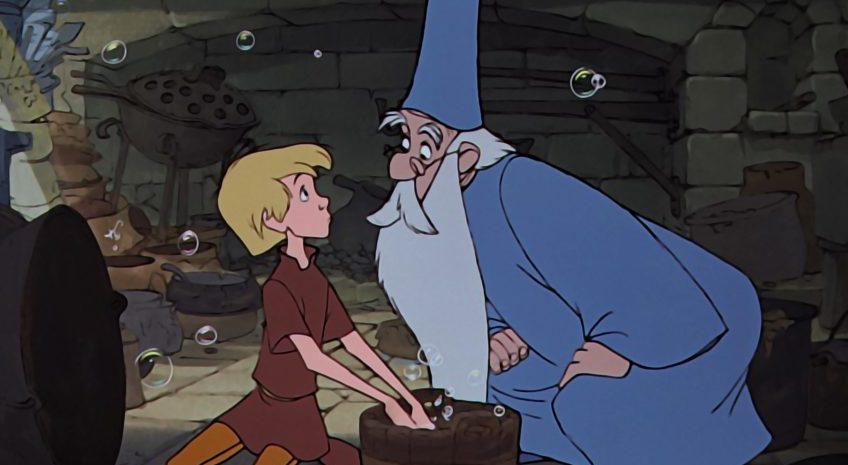
In the excerpts of White’s novel, Arthur is a naïve character
and Merlin is slightly frustrated with his lack of a personal thought process. Arthur’s
character here reminded me of his portrayal in the Camelot episodes earlier in
class. He has that “let’s go for it” attitude and wants to jump right in before
giving anything a second thought. This is Merlin’s point. Arthur just goes with
the flow of how things have always been done without stopping to evaluate if
this is a reasonable decision. “It’s not so much what you are doing,” Merlin
says, “It is how you are thinking… Are you never going to think for yourself?”
(222). Merlin wants to get Arthur out of the mindset that he needs someone to
think for him. Rather, Arthur is perfectly capable of having his own thoughts
and making his own decisions; he just needs to try! Then, when he does
try, Arthur comes up with the idea of the Round Table and that his knights will
fight for a good cause. He explains: “Why can’t you harness Might so that it
works for Right? … It will be using the Might instead of fighting against it,
and turning a bad thing into a good” (248). By thinking for himself and not
being swayed by the traditions of his culture, Arthur has come up with a new
idea to fight for the sake of good instead of fighting for the sake of fighting.
Tuesday, March 31, 2020
Did.. did I enjoy this reading?
"Once and Future King" is definitely written in a style I as a reader am more familiar with and therefore enjoy much more. (Of course, it was written mid 20th century, so it is much more modern than the other works). I really did enjoy this story more; there was actual character development! And also some great quotes. Below are several quotes I quite enjoyed from "Once and Future King":
"He had fair hair and a stupid face, or at any rate there was a lack of cunning in it" (221)
- LOL. Reminds me of the Camelot episode we watched; that Arthur definitely meets these descriptions
"It is nothing. I am due to fall in love with a girl named Nimue in a short time, and then she learns my spells and locks me in a cave for several centuries. It is one of those things which are going to happen" (224)
- This quote seems so self-aware at the arbitrary nature events that happen in these stories and I LOVE it.
"Then we must have a round table, with no top" (265)
- I love to see the origins of such iconic aspects of the Arthur's story developed in a comical, almost again arbitrary way; it makes the story more relatable in the sense? and makes me feel closer to Arthur actually. I enjoyed this whole conversation about the logistics of the round table.
"Remind me to warn you about Guinevere another time" (266)
-Oof
"There is a thing about time and space which the philosopher Einstein is going to find out" (286)
-This right here is pretty funny. White took advantage of the fact that he is writing about Merlyn a while in the 'future', so he can actually make Merlin refer to things that will happen.
"This idea was in the hearts of the young men who knelt before the God-distributing bishops-- knowing that the odds were three to one, and that their own warm bodies might be cold at sunset" (298)
-It is this type of writing that really makes this story so much more enjoyable for me; slightly poetic, referring back to the beginning of the chapter with the bishops, contemplating real-life worries, thus humbling the story itself.. Good job White. This is good stuff.

I really enjoyed this reading, so my question is, did you (the class) also
enjoy it more? Why or why not? I am very curious about how every one else felt about it compared to the others we have read.
"He had fair hair and a stupid face, or at any rate there was a lack of cunning in it" (221)
- LOL. Reminds me of the Camelot episode we watched; that Arthur definitely meets these descriptions
"It is nothing. I am due to fall in love with a girl named Nimue in a short time, and then she learns my spells and locks me in a cave for several centuries. It is one of those things which are going to happen" (224)
- This quote seems so self-aware at the arbitrary nature events that happen in these stories and I LOVE it.
"Then we must have a round table, with no top" (265)
- I love to see the origins of such iconic aspects of the Arthur's story developed in a comical, almost again arbitrary way; it makes the story more relatable in the sense? and makes me feel closer to Arthur actually. I enjoyed this whole conversation about the logistics of the round table.
"Remind me to warn you about Guinevere another time" (266)
-Oof
"There is a thing about time and space which the philosopher Einstein is going to find out" (286)
-This right here is pretty funny. White took advantage of the fact that he is writing about Merlyn a while in the 'future', so he can actually make Merlin refer to things that will happen.
"This idea was in the hearts of the young men who knelt before the God-distributing bishops-- knowing that the odds were three to one, and that their own warm bodies might be cold at sunset" (298)
-It is this type of writing that really makes this story so much more enjoyable for me; slightly poetic, referring back to the beginning of the chapter with the bishops, contemplating real-life worries, thus humbling the story itself.. Good job White. This is good stuff.

I really enjoyed this reading, so my question is, did you (the class) also
enjoy it more? Why or why not? I am very curious about how every one else felt about it compared to the others we have read.
Arthur as the antithesis to Jesus ???
While reading The Once and Future King, I was struck by how Merlyn and Kay had a conversation where they compare Arthur to Jesus Christ. Throughout the stories we have read we have seen King Arthur either being portrayed as a laid back king who lets his knights do his fighting for him or as a legendary leader that can do no wrong. When Arthur is fighting his war on the rival kings to prove that he is the rightful heir of the kingdom he says that he is doing it to, "institute a sort of order of chivalry" (White, 241). He believes that he is in the right as he is finally fighting a just war with just reasoning behind it. However, with the help of Merlyn, Kay realizes that Arthur is, "imposing his ideas on King Lot" (White, 261). I thought that this was interesting because they were not comparing Arthur as being the same as Jesus, but rather as his opposite. Jesus made the ideas available to everyone that wanted to accept it, but Arthur was forcing this idea down their throats that they needed to accept this new form of chivalry. It was also interesting to me that Merlyn did not flat out say that what Arthur was doing was wrong, but allowed for Kay to deduce this for himself. I feel as if this may come into play later that Arthur and Kay may not always see eye-to-eye on what is the best way to run the kingdom. I believe that Arthur looks more at restoring order in the kingdom, while Kay believed there should be more free will.


Monday, March 30, 2020
The Kings Secret
"This I knew," said the king, "because I saw Sir Lancelot in Sir Barnard's garden when we stayed in Astolat on the way up to Camelot. But I wonder that he wore the maid's token."
This line from King Arthur as well as the first half really have me asking the question, why? It's a little confusing how King Arthur knew the whole time who the mystery knight was, but did not reveal his identity until it was confirmed to be Lancelot. I would think that King Arthur would be in more of a rush or hurry to find Lancelot when he knew how badly he was wounded after the tournament rather than keep it secretive like he did. Also he let Lancelot ride off terribly wounded. Why didn't he help his guy out?
This line from King Arthur as well as the first half really have me asking the question, why? It's a little confusing how King Arthur knew the whole time who the mystery knight was, but did not reveal his identity until it was confirmed to be Lancelot. I would think that King Arthur would be in more of a rush or hurry to find Lancelot when he knew how badly he was wounded after the tournament rather than keep it secretive like he did. Also he let Lancelot ride off terribly wounded. Why didn't he help his guy out?
Subscribe to:
Posts (Atom)