Pages

Wednesday, April 1, 2020

Think for Yourself


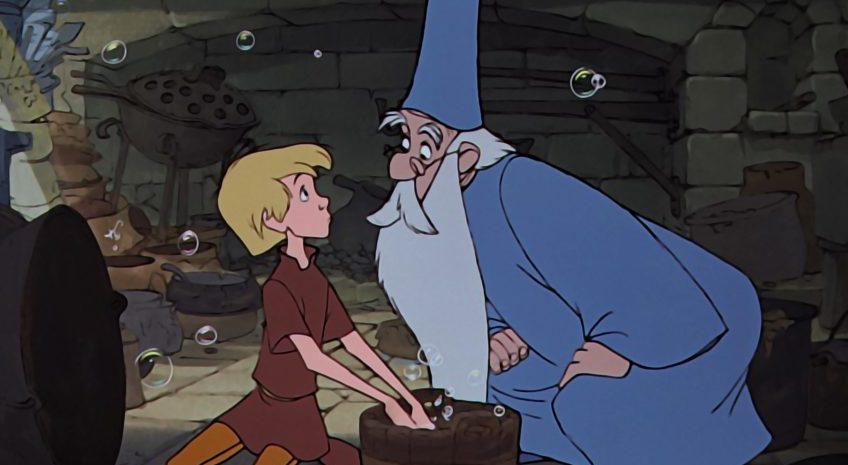
In the excerpts of White’s novel, Arthur is a naïve character and Merlin is slightly frustrated with his lack of a personal thought process. Arthur’s character here reminded me of his portrayal in the Camelot episodes earlier in class. He has that “let’s go for it” attitude and wants to jump right in before giving anything a second thought. This is Merlin’s point. Arthur just goes with the flow of how things have always been done without stopping to evaluate if this is a reasonable decision. “It’s not so much what you are doing,” Merlin says, “It is how you are thinking… Are you never going to think for yourself?” (222). Merlin wants to get Arthur out of the mindset that he needs someone to think for him. Rather, Arthur is perfectly capable of having his own thoughts and making his own decisions; he just needs to try! Then, when he does try, Arthur comes up with the idea of the Round Table and that his knights will fight for a good cause. He explains: “Why can’t you harness Might so that it works for Right? … It will be using the Might instead of fighting against it, and turning a bad thing into a good” (248). By thinking for himself and not being swayed by the traditions of his culture, Arthur has come up with a new idea to fight for the sake of good instead of fighting for the sake of fighting.

Tuesday, March 31, 2020

Did.. did I enjoy this reading?

"Once and Future King" is definitely written in a style I as a reader am more familiar with and therefore enjoy much more. (Of course, it was written mid 20th century, so it is much more modern than the other works). I really did enjoy this story more; there was actual character development! And also some great quotes. Below are several quotes I quite enjoyed from "Once and Future King":

"He had fair hair and a stupid face, or at any rate there was a lack of cunning in it" (221)

- LOL. Reminds me of the Camelot episode we watched; that Arthur definitely meets these descriptions

"It is nothing. I am due to fall in love with a girl named Nimue in a short time, and then she learns my spells and locks me in a cave for several centuries. It is one of those things which are going to happen" (224)

- This quote seems so self-aware at the arbitrary nature events that happen in these stories and I LOVE it.

"Then we must have a round table, with no top" (265)

- I love to see the origins of such iconic aspects of the Arthur's story developed in a comical, almost again arbitrary way; it makes the story more relatable in the sense? and makes me feel closer to Arthur actually. I enjoyed this whole conversation about the logistics of the round table.


"Remind me to warn you about Guinevere another time" (266)

-Oof

"There is a thing about time and space which the philosopher Einstein is going to find out" (286)

-This right here is pretty funny. White took advantage of the fact that he is writing about Merlyn a while in the 'future', so he can actually make Merlin refer to things that will happen.

"This idea was in the hearts of the young men who knelt before the God-distributing bishops-- knowing that the odds were three to one, and that their own warm bodies might be cold at sunset" (298)

-It is this type of writing that really makes this story so much more enjoyable for me; slightly poetic, referring back to the beginning of the chapter with the bishops, contemplating real-life worries, thus humbling the story itself.. Good job White. This is good stuff.

I really enjoyed this reading, so my question is, did you (the class) also
enjoy it more? Why or why not? I am very curious about how every one else felt about it compared to the others we have read.


Arthur as the antithesis to Jesus ???

While reading The Once and Future King, I was struck by how Merlyn and Kay had a conversation where they compare Arthur to Jesus Christ. Throughout the stories we have read we have seen King Arthur either being portrayed as a laid back king who lets his knights do his fighting for him or as a legendary leader that can do no wrong. When Arthur is fighting his war on the rival kings to prove that he is the rightful heir of the kingdom he says that he is doing it to, "institute a sort of order of chivalry" (White, 241). He believes that he is in the right as he is finally fighting a just war with just reasoning behind it. However, with the help of Merlyn, Kay realizes that Arthur is, "imposing his ideas on King Lot" (White, 261). I thought that this was interesting because they were not comparing Arthur as being the same as Jesus, but rather as his opposite. Jesus made the ideas available to everyone that wanted to accept it, but Arthur was forcing this idea down their throats that they needed to accept this new form of chivalry. It was also interesting to me that Merlyn did not flat out say that what Arthur was doing was wrong, but allowed for Kay to deduce this for himself. I feel as if this may come into play later that Arthur and Kay may not always see eye-to-eye on what is the best way to run the kingdom. I believe that Arthur looks more at restoring order in the kingdom, while Kay believed there should be more free will. 

Monday, March 30, 2020

The Kings Secret

"This I knew," said the king, "because I saw Sir Lancelot in Sir Barnard's garden when we stayed in Astolat on the way up to Camelot. But I wonder that he wore the maid's token."

This line from King Arthur as well as the first half really have me asking the question, why? It's a little confusing how King Arthur knew the whole time who the mystery knight was, but did not reveal his identity until it was confirmed to be Lancelot. I would think that King Arthur would be in more of a rush or hurry to find Lancelot when he knew how badly he was wounded after the tournament rather than keep it secretive like he did. Also he let Lancelot ride off terribly wounded. Why didn't he help his guy out?

Friday, March 27, 2020

Its not cool to be wounded

I felt that the purpose of this story was to emphasis the heroics and masculinity of Lancelot. To explain, there are several times in this story in which Lancelot is fighting and almost bleeding to death during battle. For example, the story says that "...if I had earned your praise, I have earned it hardly, for I am so wounded that I doubt I shall live...I am more in need of repose than honor..." (461). This is meant to show how brave and tough he is so that the readers can get more behind the idea of him. They also added a sprinkle of humbleness for good measure. However, while much of this story is trying to get the reader to enjoy the presence of him, they make some odd creative choices at times. Lancelot refuses to love Guinevere and also kind of kills her. I believe this is supposed to be an odd way of showing that Lancelot is cool since it adds a layer of tragedy and complexity to him.


Frasier is leaving Netflix on December 31st, 2019." Me: : Frasier
Lancelot at some points in the story

Thursday, March 26, 2020

How much mirror is too much mirror?

This poem left me with lots of questions surrounding her curse and her situation. The line is very grey with how she is allowed to look down on Camelot. She glances and sees different reflections out of the corner of her eye in the mirror. Would it break the curse if she blatantly used the mirror to stare down over the land? Lots of other questions remain as well. How did she receive the curse originally? How did she find out that she had the curse? Who decided that it was in her best interest to live in a tower all her life? Still, the poem was very intriguing to me. It was different to anything else we have read thus far because Lady of Shalott has a very artistic mind and the majority of the poem we as readers are tapped into this mind. It really makes me put myself into her shoes and think about what life would be like if I was to only be in one place, and to not be able to look at the only outside world I physically can.
When you walk by a mirror at a party and youre trashed - Meme Guy

Seriously? He Stood There, Nothing Else


James DeProspero
English 269
Professor MB
Seriously? He Stood There, Nothing Else

            I feel...like this story could’ve never taken place if one certain person had maybe seen another human being before in her life. Let me get this straight, the Fair Maid of Astolat would rather die than not have Sir Lancelot as her husband/paramour? To me, this makes no sense whatsoever. The two had barely even spoken before she was already announcing her love for him. Never mind the fact that after Lancelot stayed with her, he went on to physically own every Knight of the Round Table on the battlefield, she’s just going to pull a Juliet and announcer her love for him on the spot. Moving on, how could one possibly blame Lancelot as the cause of her death you may ask. One might say it’s because he didn’t marry her, or that he chose not to be her paramour: “unless you can take me for your wife or paramour, all joy must vanish from my life!” (469) Then you might wonder, like me, why he must pledge the rest of his life with this girl for her to decide she wants to live. Apparently, that’s the way this story wanted to be written, a twenty-page Rom-Com that doesn’t give the events of Arthur’s court or the love triangle the light of day. Thank you for coming to my Ted Talk.

Image result for juliet killing herself


Elaine of Astolat/The Lady of Shalott | Robbins Library Digital ...